
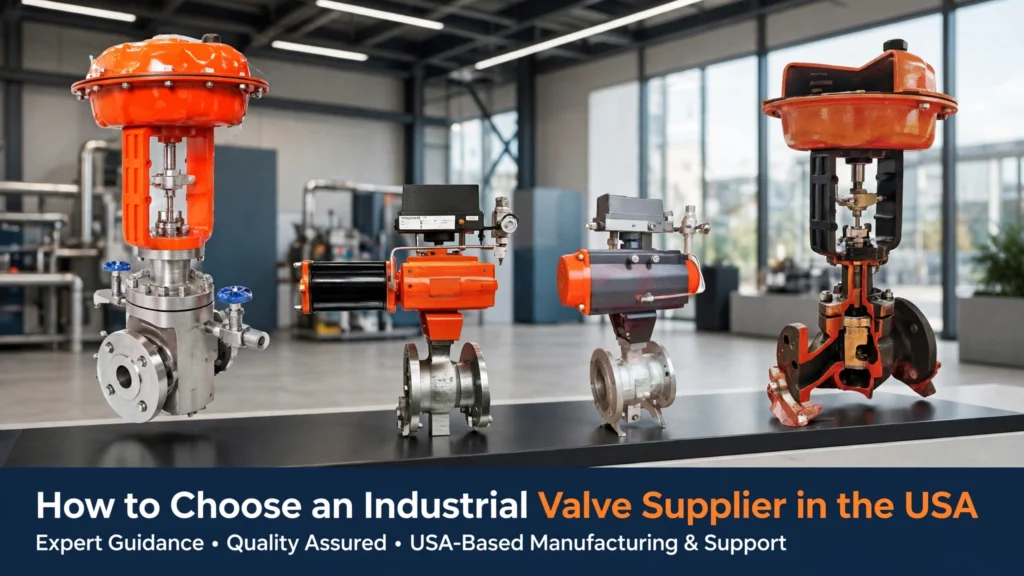
A valve is a small line item until it fails. Then it becomes an unplanned shutdown, a leaking flange, a safety incident, or a production run that never happened. That is why choosing an industrial valve supplier is not a purchasing detail — it is a reliability decision.
If you buy valves for a plant, a terminal, a water facility, or an OEM package anywhere in the United States, run these nine checks before you issue the purchase order.
1. A range that matches your service — not just your SKU
Any catalogue can list a part number. A real flow-control supplier understands the service behind it: what is flowing, at what pressure and temperature, how often the valve cycles, and what failure would cost you. Look for a supplier who covers the core valve families — ball, gate, globe, butterfly, check, and lined valves — and who asks about your application before quoting, not after.
2. Materials and lining expertise
Corrosive chemical service destroys the wrong valve quickly. For acids, caustics, and aggressive media, PTFE-lined valves exist precisely because bare metal is the wrong answer. Your supplier should be able to explain, in plain terms, when a lined valve is the right call, when an alloy is better, and where the limits of each option are — and should always confirm final suitability against the manufacturer’s published ratings for your media, pressure, and temperature.
3. Testing you can see on paper
Ask one question early: “What test documentation ships with my order?” Serious suppliers provide pressure-test records (hydrostatic and pneumatic seat/shell testing) and material traceability for the valves they deliver. If the answer is vague, expect the quality file to be vague too — usually at the worst possible moment, during an audit or a failure investigation.
4. Standards are a language — your supplier should speak it
Industrial valves are designed, built, and tested to recognised standards — ASME, API, ASTM, and ISO among them. You do not need your supplier to recite specifications. You need them to tell you clearly which standards a given valve is manufactured and tested to, and to put it in writing on the quotation. A quote without standards, materials, and end connections spelled out is not a quote — it is a guess.
5. Application help before the sale
Sizing, torque, and actuation mistakes are expensive and common. A good supplier helps you get them right up front: manual, gear, pneumatic, or electric actuation matched to the duty; fail-open or fail-closed behaviour thought through; accessories specified once, correctly. If the conversation is only about price and delivery, you are buying risk along with the valve.
6. Honest lead times and real availability
Every supplier is fast until the order is placed. Ask where the valve ships from, what is genuinely in stock in the US, and what the lead time is if it is not. Then watch how they behave when the honest answer is “three weeks” — a supplier who tells you the truth before the PO will tell you the truth after it.
7. After-sales: spares, repair, and warranty handling
Valves are maintained, not just installed. Seats, seals, and soft parts wear. Before your first order, ask how spare parts are supplied, whether repair or re-testing is available, and how a warranty claim actually works — who you call, and what happens next. The cheapest valve becomes the most expensive one the day nobody answers that call.
8. One point of contact who answers
RFQ turnaround is a preview of everything else. If a quotation takes a week and three chasers, imagine a problem during commissioning. Choose a supplier with a named contact, direct communication, and a quote that comes back complete: price, lead time, documentation, and terms — not a number that needs five follow-up emails to interpret.
9. Presence where your plants are
For Gulf Coast energy, petrochemical, and industrial facilities, a Houston-based supplier is not a small advantage. Same time zone, same-day conversations, and a team that understands the operating environment your equipment runs in. National shipping matters — local accountability matters more.
Red flags worth walking away from
- A quote with no datasheet, no materials, and no test standard named
- A price far below everyone else with no explanation
- No test certificates or material documentation available
- Nobody can tell you where the valve ships from
- Pressure to order before your technical questions are answered
How Elite Flow Control USA works
Elite Flow Control USA LLC is a Houston-based flow-control company supplying industrial valves — including PTFE-lined and ball valve ranges — to customers across the United States. Our approach follows the checks above: understand the service first, quote with documentation and standards in writing, and stay reachable after the order ships.
Browse our valve range, or send us your line list and let us quote it properly.
Request a quote: Contact Elite Flow Control USA — tell us the media, pressure, temperature, and connection, and we will come back with a complete, documented quotation.